Kryterium Kelly’ego a ruletka
Kryterium Kelly'ego gŏdŏ grŏczowi z przewŏgōm, wiela postawić. Dlŏ ruletki dŏwŏ jasnõ ôdpowiydź: nic.

Stawka Kelly'ego = przewŏga / szanse. Przi ujymnyj przewŏdze wzōr dŏwŏ ujymny ułōmek, co znaczy: niy stawiej. Kryterium dalij pōmŏgŏ zrozumieć, czamu grŏcze, co wykorzystowali skrziwiynie koła, ustŏwiali stawki tak, jak to robili, i czamu wszyjscy inksi winni je ustŏwiać podug budżetu.
Kryterium
John Kelly (1956) asked how a gambler with a known edge should size bets to maximize long-run growth of the bankrollpieniōndzeBankrollCŏłko suma ôdłożōno na granie. Zarzōndzanie bankrollym to je decydowanie, wiela z niego ryzykować na jedyn zakłŏd i na jednõ sesjã.Czytej cŏłość →. The answer, for a bet paying b to 1 with win probabilitymatymatykaPrawdopodobiyństwoSzansa wyniku, ôd 0 do 1 abo ôd 0% do 100%. Jedyn numer: 1/37 = 2,70%.Czytej cŏłość → p and loss probability q = 1 − p, is to stake the fraction f* = (bp − q) / b of the bankroll. Positive f* means bet that fraction; zero or negative means do not bet. Kelly worked at Bell Labs, and his paper, “A new interpretation of information rate”, set the problem in Claude Shannon’s theory of information: a gambler who gets tips over a noisy line, at fair odds, can grow the bankroll at best at the rate the line carries information. This is a growth objective under a probability model, not a promise to finish ahead after a particular number of bets. A spending limit, finite deadline or payoutpieniōndzeWypłataTo, co ôddŏwŏ wygrany zakłŏd, podŏwane jako „X do 1” na wiyrchu ôddanyj stawki.Czytej cŏłość → cap changes the decision problem.
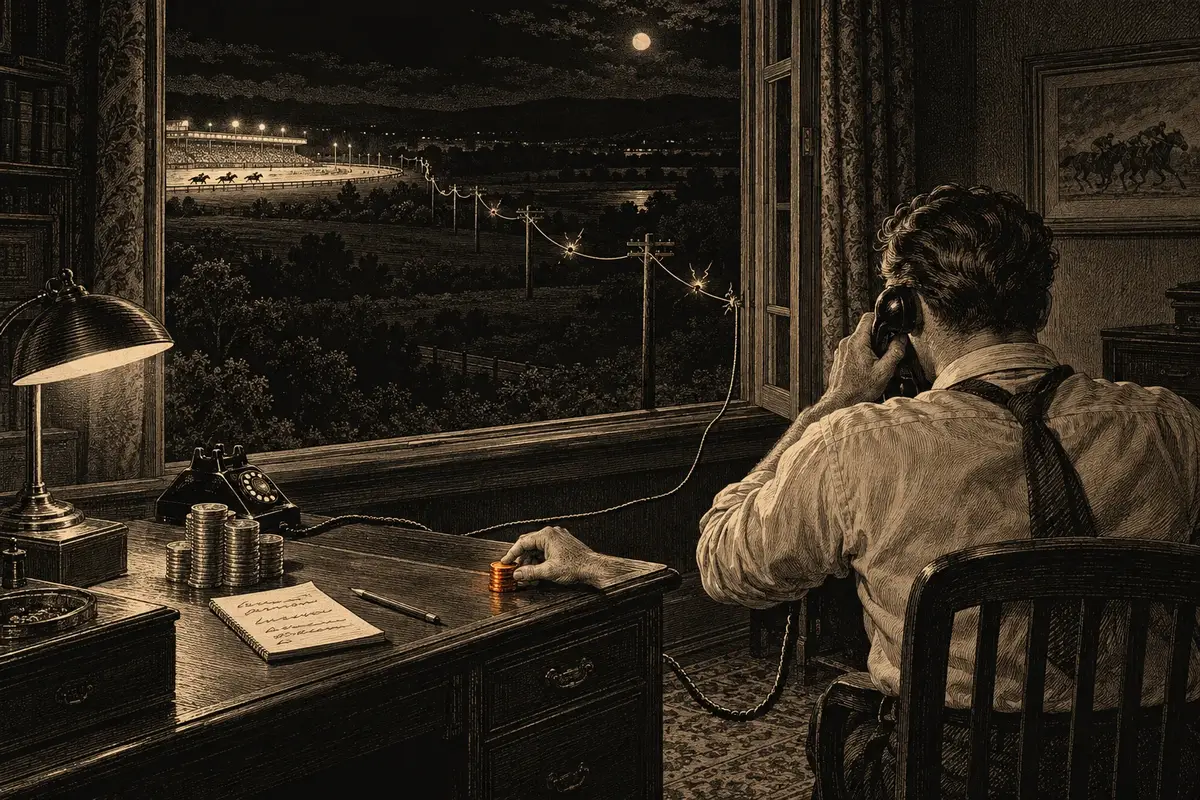
Stawianie podug Kelly'ego w ruletce
For redzakłŏdCzerwōneSzansa prosto na 18 czerwōnych numerōw. Po francusku: rouge.Czytej cŏłość →: b = 1, p = 18/37, q = 19/37; f* = (18/37 − 19/37)/1 = −1/37. For a straight upzakłŏdJedyn numer (straight up)Jedyn numer, płaci 35:1.Czytej cŏłość →: b = 35, p = 1/37, q = 36/37; f* = (35/37 − 36/37)/35 = −1/1295. Every standard bet gives a negative Kelly fraction, because every bet has a negative edge, and the growth-optimal stake is zero. Kelly betting on roulette is a formal way of saying what the house-edge page says: no positive stake maximizes expected logarithmic growth when the bet has negative expectation. A particular session can still end in profit. La partagereglaLa partageFrancusko regla: kej wypadnie zero, połowa stawki na szansie prostyj wrŏcŏ. Zmyńszŏ przewŏgã kasyna na tych zakładach do połowy, do 1,35%.Czytej cŏłość → needs a separate three-outcome calculation: a win, a full loss or a half-loss on zerokołoZeroJedyno zielōno przegrōdka, kerõ niy pokrywŏ żŏdno szansa prosto, tuzin ani kolumna; źrōdło przewŏgi kasyna. Tyż: pojedyncze zero, 0.Czytej cŏłość →. Its expected log growth also falls as the stake increases from zero.
Kaj Kelly sie nadŏwoł
Suppose a pocketsprzyntPrzegrōdkaJedna z 37 numerowanych przegrōdek na rotorze. Tyż: slot, miseczka.Czytej cŏłość → really has a stable, known probability of 1 in 30 and pays 35 to 1. The Kelly fraction is 0.57%: about $57 from a $10,000 bankroll. Under independent spinsmatymatykaNiyzależne spinyKożdy spin mŏ te same prawdopodobiyństwa, niy ważne, co bōło przedtym. Podstawa kożdego wyliczynio na tyj zajcie.Czytej cŏłość → and exact fractional staking, the geometric growth factor over 1,000 spins is about 1.7. Expected bankroll grows faster because rare large wins pull up the average. These are model calculations, not evidence that any named historical player used Kelly or achieved this result.
Typowy i strzedni
The gap between the typical bankroll and the average one is wide. Take a pocket that hits 1 time in 25, a hypothetical edge of 44% per unitpieniōndzeJednostkaBazowo stawka, w keryj liczy system abo grŏcz. Progresyje ôpisuje sie w jednostkach, coby pasowały do kożdego stołu.Czytej cŏłość → staked. Kelly stakes 1.26% of the bankroll on it. After 1,000 spins the typical bankroll has grown about 11.5 times, while the average, pulled up by a few very lucky runs, has grown about 249 times. Betting more than Kelly raises the average and lowers the typical result: at twice the Kelly stake the typical bankroll only doubles, and by two and a half times the Kelly stake it shrinks, although every bet still carries a 44% edge. In this example, half-Kelly retains about 78% of the expected log growth. This fraction depends on the probabilities and payout.
Kej przewŏga je ino zgadywaniym
Kelly uses the true probabilities, but a player usually has only estimates. Selecting the busiest pocket from a past record creates a selection problem: even a fair wheel has a busiest pocket. Its observed rate can overstate its future probability. Choosing the stake from that same record compounds the error. An independent follow-up sample helps test a proposed bias (see How to Detect Roulette Wheel Bias). Reducing the calculated fraction reduces exposure, but cannot turn a false edge into a real one.
Ludzie z przewŏgōm
Haghani and Dewey (2016) studied 61 participants given $25 and 30 minutes to bet on a simulated coin with a disclosed 60% chance of heads. The payout cap was $250; its value was revealed when a proposed winning bet would reach it. Their reported 21% success category included balances of at least $200, while the 28% “bust” category meant less than $2, not necessarily zero. Eighteen participants bet their entire balance on one flip. The uncapped Kelly fraction is 20%, but the cap and deadline change the optimization problem. The experiment illustrates how stake choices matter even with a known advantage; it does not establish one best strategy for every objective.
Co stosować miast tego
Bez przewŏgi ustŏwianie stawki to sprawa budżetu, a niy wzrostu: stawka to tela, wiela chcesz wydać na spin, wyliczōne z godzinowego budżetu i tympa stołu (zajta ô zarzōndzaniu bankrollym). Wkłŏd Kelly'ego dlŏ zwykłego grŏcza to jasność jego ôdpowiedzi: zero. Wszyjsko, co stawiŏsz nad zero, to cyna granio, kerõ ôbiyrŏsz ty, a niy żŏdyn wzōr.
Pŏrã słōw ô ułōmkowym Kellym i „zarzōndzaniu pieniyndzmi”
Betting a fixed percentage of the current bankroll is proportional staking: the stake rises after wins and falls after losses. Flat bettingstrategijŏGranie stałōm stawkōmStawianie tyj samyj sumy w kożdym spinie. Pōnkt ôdniesiynio, z kerym sie porōwnuje kożdo progresjŏ.Czytej cŏłość → instead keeps the cash stake fixed. Neither creates an edge on ordinary roulette. With infinitely divisible stakes and a fraction below 100%, proportional staking never reaches exactly zero in finitely many losses, but the balance can become arbitrarily small. Real table minimums can prevent further play much sooner. The growth-optimal fraction remains zero.
Wzōr
Pytania
Only when the actual probabilities, payouts and conditions give a credible positive advantage. Standard bets on an unbiased wheel have no such advantage.
Using half the calculated fraction reduces exposure to errors in the estimated edge. The familiar three-quarters-growth rule is an approximation for small advantages, not a universal identity. It does not protect against an edge that does not exist.
Niy. Kelly szuko nojlepszego wzrostu, kej je przewŏga. Zarzōndzanie bankrollym trzimie wydatki w ryzach, kej przewŏgi niy ma.
Matymatyka na wesoło
Nojpiyrw sprōbuj je rozwiōnzać samymu. Kożde rozwiōnzanie je zwiniyte; rozwiń je, kej bydziesz chcieć.
Suppose a hypothetical bet on one number has a known 44% edge under standard payoutspieniōndzeWypłataTo, co ôddŏwŏ wygrany zakłŏd, podŏwane jako „X do 1” na wiyrchu ôddanyj stawki.Czytej cŏłość → and independent spinsmatymatykaNiyzależne spinyKożdy spin mŏ te same prawdopodobiyństwa, niy ważne, co bōło przedtym. Podstawa kożdego wyliczynio na tyj zajcie.Czytej cŏłość →. Kelly gives a 1.26% bankrollpieniōndzeBankrollCŏłko suma ôdłożōno na granie. Zarzōndzanie bankrollym to je decydowanie, wiela z niego ryzykować na jedyn zakłŏd i na jednõ sesjã.Czytej cŏłość → fraction. What if the same 44% edge came on one bet spread over five neighboring numbers?
Pokŏż rozwiōnzanie
Ôdpowiydź Wtynczas Kelly kŏże stawiać 7,1% bankrollu, a bankroll rośnie skoro szejś razy gibcij: kole 1,25 milijōna razy bez 1 000 zakładōw, przeciw kole 11,5 razy.
A straight upzakłŏdJedyn numer (straight up)Jedyn numer, płaci 35:1.Czytej cŏłość → with a 44% edge wins with chance 0.04, since 36 × 0.04 = 1.44. Kelly’s stake is the edge divided by the odds: 0.44/35 = 1.26%. The typical growth per bet is 0.04 × ln(1 + 35 × 0.0126) + 0.96 × ln(1 − 0.0126) ≈ 0.00244, so 1,000 bets multiply the bankroll by about e^2.44 ≈ 11.5.
Spread one stake over five numbers and the bet wins with chance 0.20 and pays 36/5 for 1, that is 6.2 to 1: still a 44% edge, since 0.2 × 7.2 = 1.44. Kelly’s stake becomes 0.44/6.2 = 7.10%, and the growth per bet 0.01404, about 5.75 times as much. Over 1,000 bets that is e^14.04, about 1.25 million.
The edge is the same; the swings are smaller. A bet that wins one time in five has a larger growth-optimal fraction in this model, although losses can still reduce the bankroll severely. This comparison assumes the same known edge for both bets; actual predictions need independent evidence.
Assume two numbers are adjacent on the betting layoutsprzyntPole zakładōwWydrukowano siatka zakładōw na stole. Tyż: stōł, sukno.Czytej cŏłość → and each has a stable, known probabilitymatymatykaPrawdopodobiyństwoSzansa wyniku, ôd 0 do 1 abo ôd 0% do 100%. Jedyn numer: 1/37 = 2,70%.Czytej cŏłość → of 1 in 25 on independent spins. Compare a splitzakłŏdSplitDwa sōmsiednie numery, płaci 17:1.Czytej cŏłość → between them at 17 to 1 with equal straight-up stakes on the two numbers. How much does Kelly say, and how fast does the bankroll grow compared with one such pocketsprzyntPrzegrōdkaJedna z 37 numerowanych przegrōdek na rotorze. Tyż: slot, miseczka.Czytej cŏłość →?
Pokŏż rozwiōnzanie
Ôdpowiydź To niy robi rōżnicy: 2,59% bankrollu na split abo 1,29% na kożdy numer. Typowy bankroll rośnie kole 155 razy bez 1 000 spinōw, przeciw 11,5 razy z jednōm przegrōdkōm.
The split wins with probability 2/25 = 0.08 and pays 17 to 1, so it returns 18 × 0.08 = 1.44 per unitpieniōndzeJednostkaBazowo stawka, w keryj liczy system abo grŏcz. Progresyje ôpisuje sie w jednostkach, coby pasowały do kożdego stołu.Czytej cŏłość → staked: an edge of 44%, the same as one biased pocket. Kelly’s stake is the edge divided by the odds: 0.44/17 = 2.59%.
Two straight-up bets of 1.29% each give exactly the same results. When either number comes up, one chippieniōndzeŻetonZnak, kery wŏży stało suma; kładzie sie go na pole zakładōw, coby postawić zakłŏd. Tyż: check.Czytej cŏłość → wins 35 to 1 and the other is lost, a net of 34 × 1.29% = 44% of the bankroll, as the split pays; when neither does, both are lost.
The growth per spin is 0.00505, against 0.00244 for one pocket, so over 1,000 spins the typical bankroll grows e^5.046 ≈ 155 times rather than e^2.44 ≈ 11.5 times. The geometric growth factor is larger because the combined bet wins more often at the same 44% edge. It is a model result, not a guaranteed bankroll.
Chwila ôddychu
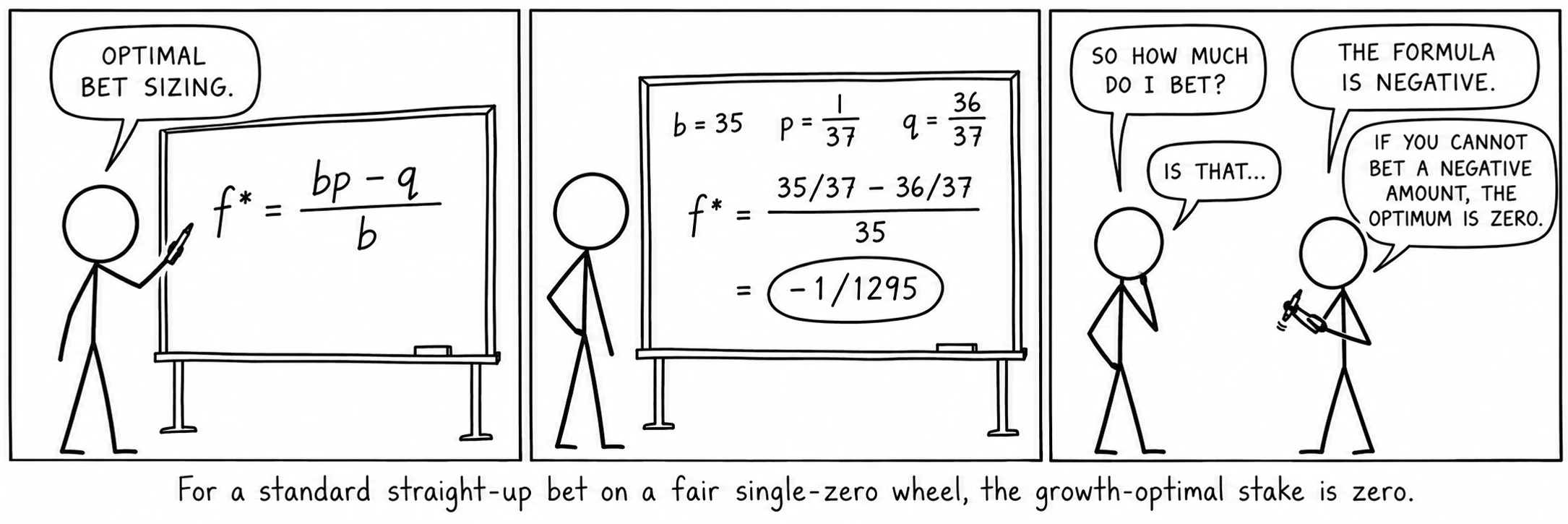
Nojlepszŏ dlŏ wzrostu stawka w ruletce to liczba, kerõ wszyjscy już znajōm.
Źrōdła
- Kelly, J. L. “A new interpretation of information rate.”
- Breiman, L. “Optimal gambling systems for favorable games.”
- Thorp, E. O. “Optimal gambling systems for favorable games.”
- Thorp, E. O. The Mathematics of Gambling.
- Epstein, R. A. The Theory of Gambling and Statistical Logic, 2nd ed.
- Taylor, D. G. Games, Gambling, and Probability: An Introduction to Mathematics, 2nd ed.
- Ethier, S. N. The Doctrine of Chances: Probabilistic Aspects of Gambling.
- Haghani, V. & Dewey, R. “Rational decision-making under uncertainty: observed betting patterns on a biased coin.”