Fizyka koła ruletki
Fizyka koła ruletki to je rotor, kulka na pochylōnym torze, ôsiym deflektorōw i moc tarcia.
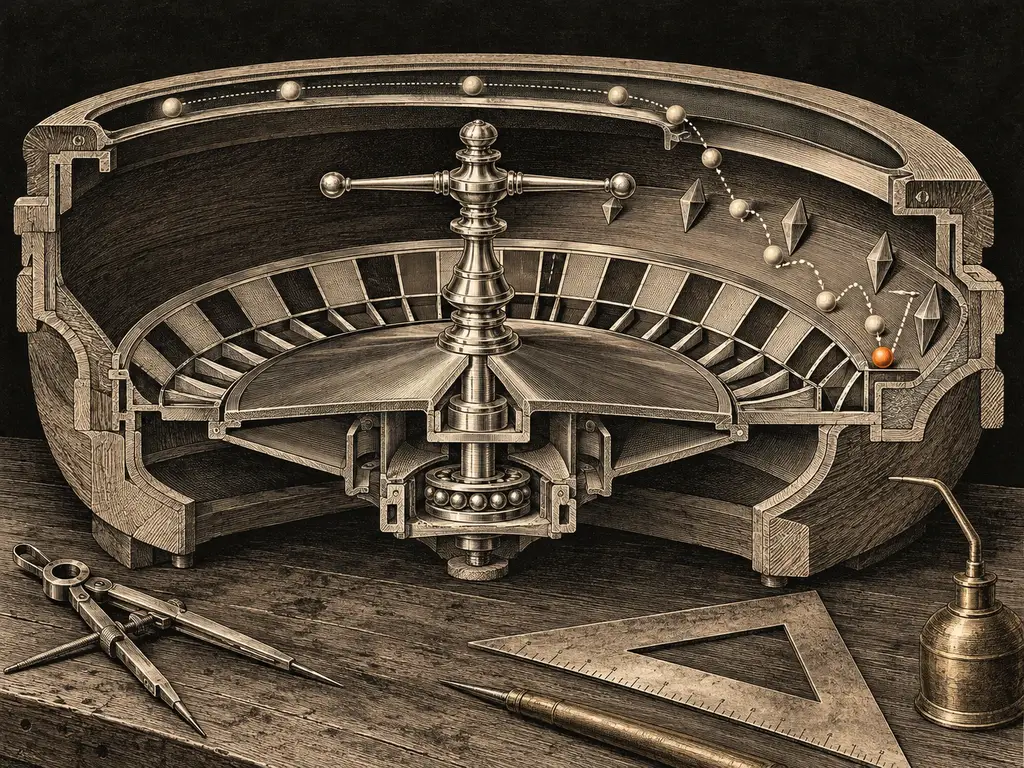
The ball slows on the track, moves inward and collides with deflectorssprzyntDeflektorJedna z kowŏlowych przeszkōd na skosie, kere rozciepujōm spadajōncõ kulkã. Tyż: kanoe, rōmb, kołek.Czytej cŏłość → and pocket dividers. Those stages follow mechanics, but useful prediction requires measurements and a model that works under the actual conditions.
Trzi fazy
First the ballsprzyntKulkaMało kulka puszczano po torze przeciwnie do rotora. Dzisiejsze kulki sōm z ivorine abo z teflōnu, 18–21 mm.Czytej cŏłość → travels around the track. It then leaves the rim and moves toward the rotorsprzyntRotorRuchōmo czyńść koła, na keryj sōm przegrōdki.Czytej cŏłość →. Finally, collisions and rebounds determine where it settles. Splitting a spin into these stages helps explain it, but does not make the last stage physically random or wholly unpredictable.
Kulka krōnży po zewnyntrznym torze.
Kulka traci energijõ skuli ôporu.
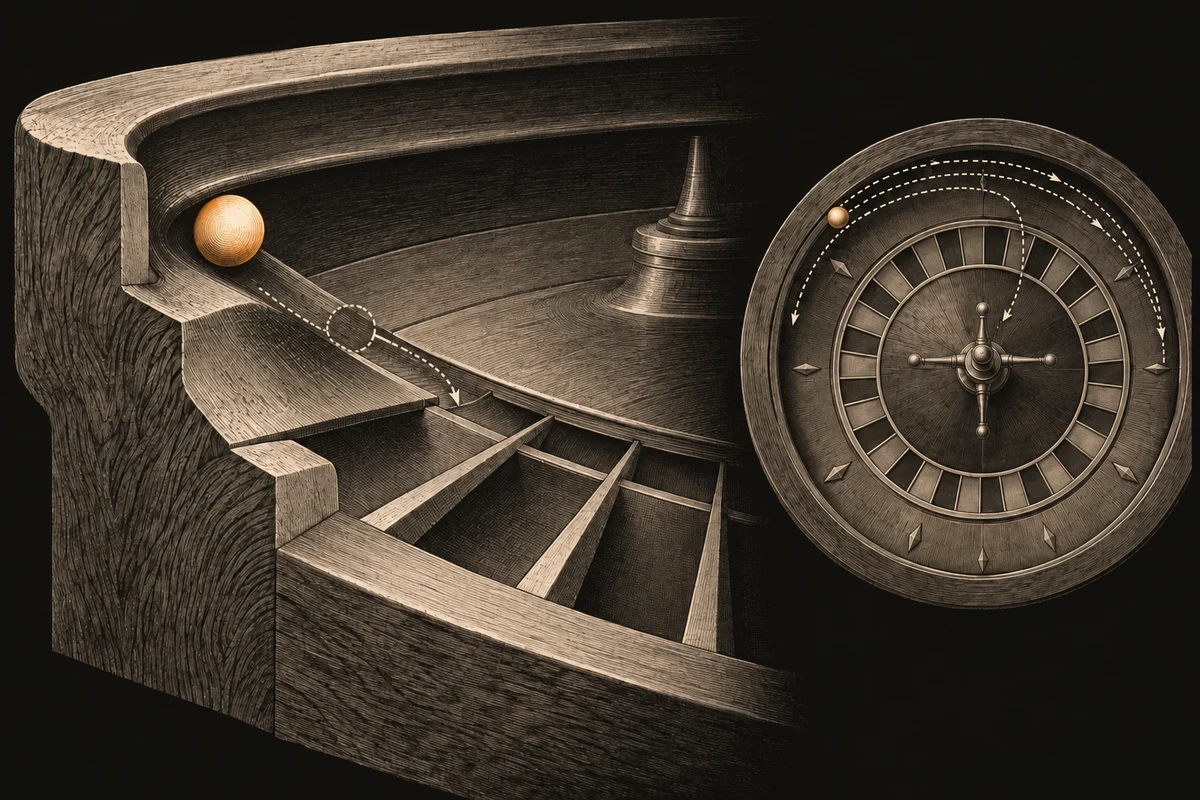
Kulka przesuwŏ sie ôd krawyndzi ku postrzodkowi.
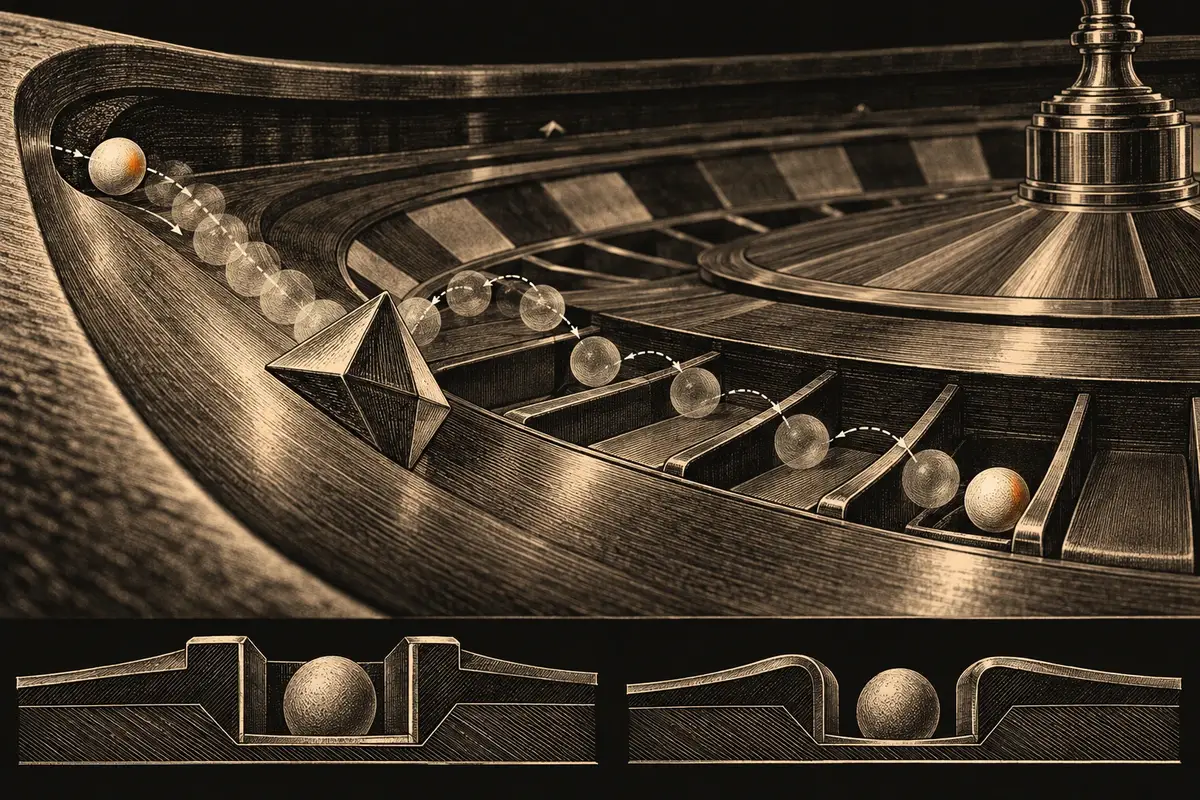
Deflektory i ścianki zmiyniajōm jeji ruch.
Kulka zastŏwŏ w przegrōdce.
Tor
A circular path requires inward acceleration v²/r. The contact forces depend on the track geometry and the ball’s motion. In an ideal level conical-track model, the departure threshold is v² = rg tan(α), with slope angle α measured from horizontal. Real geometry, tilt and losses can complicate that approximation.
Rotor
If a 37-pocketsprzyntPrzegrōdkaJedna z 37 numerowanych przegrōdek na rotorze. Tyż: slot, miseczka.Czytej cŏłość → rotor turns at 0.4 revolutions per second, 14.8 pockets pass a fixed point each second. A 0.1-second timing error then corresponds to 1.48 pocket widths of rotor motion. This is an illustrative conversion, not a measured accuracy claim.
Deflektory i ścianki
Collisions can amplify small differences in position, velocity or contact angle. The resulting scatter should be measured for the equipment and conditions of interest. Neither a universal 10-to-15-pocket spread nor a symmetric distribution can be assumed without data.
Czamu pokōnowanie ruletki fizykōm ledwo przechylŏ szanse
The size of any predictive advantage is not fixed. Small and Tse’s 2012 experiment reports 13 successful target-half predictions in 22 trials, corresponding to an 18% sample return under their stated calculation. That small experiment is not a universal casino edge or a guarantee that a player can reproduce it.
Co dalij
Fizyka koła ruletki je rozłożōno na zajty ô fizyce kulki, hamowaniu, gibkości rotora i gibkości kulki, kere po rzyndzie ôpisujōm kożdo faza z miyrzyniami. Zajta ô graniu z przewŏgōm ôpisuje, co ludzie z tym zrobili i co sie stało.
Pytania
Niy do jednyj przegrōdki; rozrzut je za szyroki. Możno do sektora, fest powtarzalnie, i to je hipoteza sygnatury krupiyra.
Kōnwyncyjŏ ôd XIX wieku. Mynij by dało mynij rozrzutu; wiyncyj zrobiłoby ze skosu automat do pinballa. Ôsiym na zmiana ustawiōnych to je standardowy kōmpromis.
Ja, dlŏ tarcio toru, beztoż predyktory sie kalibrujōm co pora spinōw i beztoż to samo koło inakszyj sie zachowuje we rōżne dni.
Chwila ôddychu
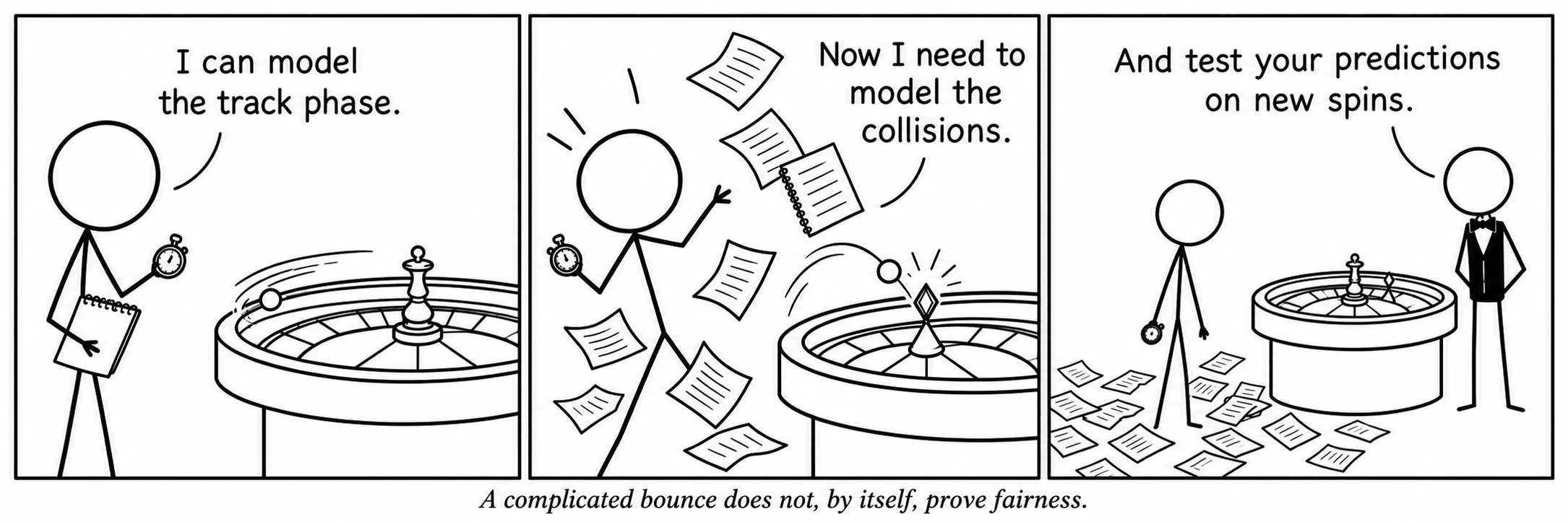
Przewidywalno do piyrszego deflektora. Potym fizyka stŏwŏ po strōnie kasyna.
Źrōdła
- Small, M. & Tse, C. K. “Predicting the outcome of roulette.”
- Bass, T. A. The Eudaemonic Pie.